Recovered food is sourced from countless businesses, and is donated for equally as many reasons. Some food comes from the excess that is produced intentionally to cover customer satisfaction in the event of an exchange or return. Other food items get caught in traffic during transit and arrive too late for grocers to meet the “sell-by” date. What is common across the country and throughout the entire food industry is the immense amount of food that never makes it to people’s dinner plates.
The Bill Emerson Good Samaritan Food Donation Act was passed in 1996 to shield food donors from criminal and civil liability, and as a result, encourage more food donations. The burden of food safety is transferred to the nonprofits and organizations receiving the food, and businesses are free to decide what food they donate.
It seems counterintuitive, but the Act is regularly cited by businesses as the reason they choose not to donate food. Something has to change when the Act that is meant to protect donors becomes a confusing and discouraging hurdle.
This is where the new, proposed Food Donation Improvement Act comes into play. It would update the 1996 Act, making it easier for people to donate food and to feel more comfortable with the process. The current Act does not have a specific agency in charge of clarifying the details, nor does it explicitly address many of the common circumstances in which a business or farm might donate food. Many business owners find the vague language concerning, and don’t have an immediate or official source of guidance.
The update would require the USDA to release regulations clarifying the protections that exist, the businesses and agencies that can donate, and which businesses (nonprofits, schools, food banks, etc.) they can donate food to.
In addition to the clarification, it would also extend liability protection to food businesses and farms that want to donate food directly to people in need without going through a registered nonprofit. A restaurant shut down by the pandemic that wants to serve community meals would be protected, as would a school that wants to send surplus food from meal programs home with low-income families. Finally, it would also cover organizations and companies that want to take surplus food and sell it at a very low cost—such as nonprofit grocery stores that accept donations.
The response to the Food Donation Improvement Act has been overwhelmingly positive from lawmakers and policy experts, with the sentiment being that making food donation easier is just common sense. It is a straightforward way to reduce greenhouse gas emissions on a national scale and will increase food access as well.
And while activists acknowledge that the bill alone will not solve hunger, it represents an important step in reducing food insecurity and protecting the environment. Chef and advocate Tom Colicchio also argues that preventing food waste is a matter of showing respect for the food that nourishes eaters and the workers who produce it. By wasting food, he says, “we’re devaluing not just the food, but we’re devaluing the people who are responsible for feeding us.”
We Don’t Waste has signed the petition in support of this act, as it directly aligns with our goal of using food recovery and distribution as a means to support our environment and increase food access in our communities. To learn more and support this initiative, sign the petition here.
It’s Pride Month—a time to celebrate the diversity in Denver and the richness it brings to our community! But, while we celebrate, it is also important to reflect on the inequities in the present that we can work to solve. Though LGBTQ Americans have seen rapid advancements in both societal acceptance and civil rights protections in recent years, food insecurity continues to affect the community at higher rates than the general population.
In 2021, (for the first time ever!) the U.S. Census Bureau asked about sexual orientation and gender identity in the Household Pulse Survey. This survey was sent to measure different social and economic experiences of U.S. households throughout the pandemic, and as a result, can compare the experiences of LGBTQ adults with other groups.
Of the more than 64,000 people who responded to the bureau’s latest Household Pulse Survey, over 13% of LGBTQ adults reported living in a household that experienced food insecurity in the past seven days, compared to 7.2% of non-LGBTQ adults. If there was any uncertainty about a discrepancy in the demographics, there is none now.
The survey also revealed the extent to which many LGBTQ Americans are struggling with economic insecurity. According to the results, 36.6% of LGBTQ adults reported living in a household that struggled to pay for expenses in the past seven days, with over 8% saying they were not confident they could afford to make their next housing payment on time. By comparison, just over one-quarter of adults who do not identify as LGBTQ reported experiencing economic insecurity.
A recent Gallup survey shows that 5.6% of the American population currently identifies as LGBTQ. The problem is not insignificant.
Fortunately, there are lots of organizations in Denver working to support LGBTQ youth and adults. Some of the larger organizations like The Center on Colfax and One Colorado are working to support the community through a long list of programs and free resources from mental health to legal representation.
There are a few organizations We Don’t Waste works with directly that help fight food insecurity in the LGBT community as well. We provide food to the Colorado AIDS Project as a part of the Colorado Health Network, and The Delores Project, which provides shelter to women and transgender individuals experiencing homelessness. We Don’t Waste began working with the The Delores Project in 2011 and has been delivering food to support their food programs on-and-off since.
“What began as a winter-only shelter has now morphed into a robust 24/7 low-barrier, housing-focused 50-bed shelter with rehousing case management and wrap-around support. Our team embraces a housing-first model of care, working to get individuals out of the shelter system and into housing as quickly and safely as possible while providing the necessary support before, during, and after the transition into housing,” says Stephanie Miller, CEO of The Delores Project.
Being a 24/7 shelter means providing regular food to their program participants, and lots of it! The Delores Project serves three meals and two snacks a day to their residents alongside many other essential services. Food program costs can be a massive financial burden for nonprofit organizations, especially with rising grocery costs due to recent inflation rates. Fortunately for The Delores Project, they receive some help from the community.
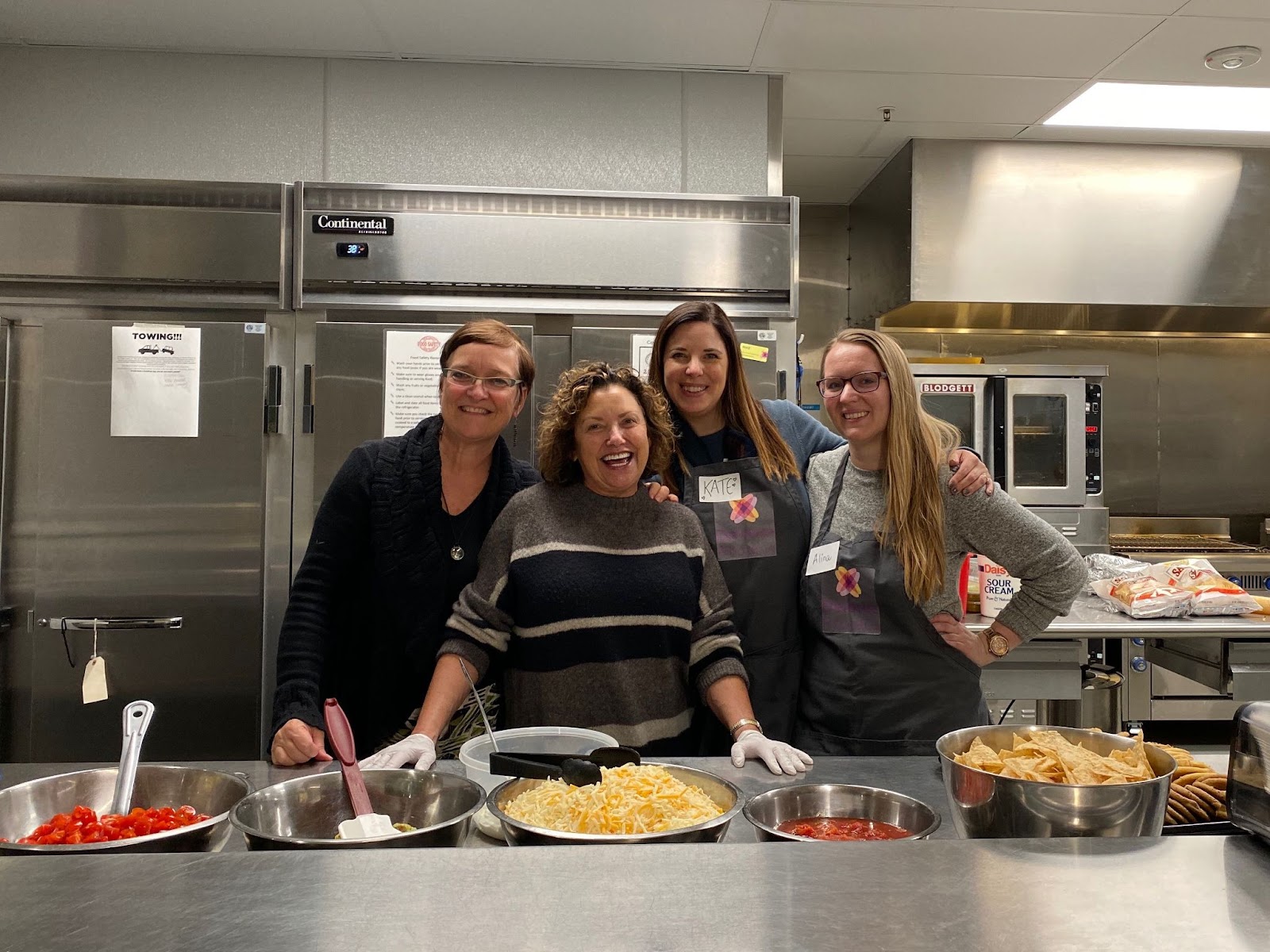
Volunteers serving tacos for dinner during a Taco Tuesday event.
“About 52% of the meals served in our shelter is donated,” Stephanie says. A few thousand pounds of that each month comes as recovered food from We Don’t Waste!
In addition to the meals, they offer a food pantry for their residents in shelter and those transitioning out of shelter and into permanent housing. It’s just one of the many ways they help create longterm solutions for the women, seniors, and transgender adults that seek support through their programs. Through free shelter, meals, mental-health education, and transitional housing programs, The Delores Project has created a system that allows for dozens of adults each year to transition from homelessness into stable and secure independence.
The shared dining hall for the residents of The Delores Project.
One of the ways We Don’t Waste is unique as an organization is our network of nonprofit partners, through which we are able to distribute millions of servings of food each month. Through our connection with The Delores Project, we are able to contribute to hundreds of free, nutritious meals each month for transgender and gender-expansive people in an environment where they can thrive in a community of specialized support.
This Pride Month, consider making a gift to support organizations uplifting the LGBTQ community.
Eco-anxiety, climate change anxiety, environmental paralysis. It goes by many names but can be described as the overwhelming feeling of stress and despair you get when you consider the environmental damage done by humans in the last century. It’s a complex feeling, and can be a different experience from person to person.
You’re browsing the news and you see that another species has gone extinct, or a photo of our oceans full of plastic. This can inspire feelings of guilt, stress, anxiety, or even grief. It is concerning, and you should respond with concern to news like this because you care about the future of our planet; that said, it is important to re-center ourselves, and not let the despair prevent us from taking action.
After all, there is more news coming out and studies published every day that show that many environmental problems are reversible, and with some effort, we have seen some pretty major environmental impacts out of efforts made around the world.
So what do we do to get over that feeling?
Do something about it!
It can feel impossible to make an impact when a lot of the damage is being done by multinational corporations, but there are ways you can make a major difference in your own neighborhood! Action is the best way to get over the feeling of hopelessness. Volunteer with a local organization working to make a change in your backyard! We Don’t Waste works to support our local environment by preventing as much food from going to our landfills as possible (which prevents highly volatile methane emissions). DUG and RE:Vision both allow you to participate in local community gardens and create free food for those in need.
Take a break from the news.
It can be hard to escape bad news when it seems to be the only kind of news presented to us on a daily basis. Try to go a day or two without looking at the news. Unless your job requires you to stay up to date on everything the minute it’s happening, you won’t be too out of the loop by giving yourself a short break. In fact, studies show that we often consume too much media, which causes our nervous system to be overloaded with information and can lead to increased stress and anxiety in our daily lives.
Oyster mushrooms are capable of decomposing plastic, and they’re edible!
Focus on the GOOD
Believe it or not, there are countless groups working around the clock, all over the world, that are making a difference every day! There have been incredible innovations in green technology, more global political support, greater importance placed on systemic issues, and measures being taken to protect the most at-risk and important ecology. Did you know that there is a species of fungi that can eat and decompose plastic? And there are kelp forests being planted in the ocean to absorb atmospheric carbon and sink it deep into the ocean where it can be consumed by fish and completely removed from the cycle. How cool is that!
If podcasts are your thing, the Intersectional Environmentalist runs a podcast, The Joy Report, that focuses on news in climate solutions and environmental justice, but exclusively from an optimistic and joyful perspective!
Let the feelings out, and let others know
You are not the only person experiencing these feelings. As more and more people become aware of the importance and the severity of climate change, more are experiencing eco-anxiety. In the first tip, we mentioned volunteering with local environmentally-based nonprofits. These can be a great way to connect you with other people working to heal our planet. There are also lots of clubs and groups that meet virtually and in-person that can offer you some support. Look for Facebook groups in your area focused on conservation efforts, or organizations supporting political action in your local government.
Produce bags can help reduce plastic usage with each grocery trip.
Make sustainable changes at home
Sometimes even the smallest changes in your daily routine can lead to a larger personal impact, and can help reduce those feelings of helplessness over time. You can reduce your single-use plastic by swapping out products you currently use with others using more sustainable packaging like recycled cardboard or glass. Buy fruits and vegetables that aren’t packaged in plastic, and use your own produce bags when you shop.
It can be small changes like setting a timer for your showers or something as large as installing solar panels on your home. Everyone has access to different solutions, and what you can incorporate into your lifestyle will be different from your neighbor. Just figure out what makes sense for you, and don’t try to change everything at once! Not only will it feel good to make these changes in your life, but you’re voting with your dollar, a powerful tool for change.
Learn more about climate solutions
By better understanding the issues surrounding climate change and environmentalism, you won’t fall prey to the dramaticized and melodramatic news stories meant to make you click on an article out of fear and confusion. It can also help you feel more connected to the planet, and inspire feelings of wonder and admiration for the planet we live on.
Braiding Sweetgrass by Robin Wall Kimmerer is an excellent example of compassion and appreciation for nature from an indigenous lens, and one that sees plants as our partners on the planet, not as tools.
How to Be a Climate Optimist by Chris Turner covers a dozen climate-related projects around the world, all working to save our planet with innovative technology and proactive communities.
There are many ways to consider eco-anxiety and how it may play a role in our sustainability journey. Remember to validate your concerns without dismissing your power to drive change. Feel your feelings and let them motivate you to take action. Eco-anxiety may be a familiar or foreign feeling to you, but regardless, we have many opportunities to healthily manage our emotions and transform our worries into meaningful action.
Food Waste Prevention Week is April 4th – April 8th, and we invite you to celebrate with us! Food waste is something many American households struggle with, but, fortunately, there are some easy ways to reduce it and make a BIG impact.
Food waste costs you! Every year, the average household spends $1,600 on food that ends up in the trash. Nobody wants to lose that money!
It also wastes the time and the effort of the countless people working hard fertilizing, watering, harvesting, and delivering that food to your door. And that’s not all; the wasted food does further damage to our beloved outdoor space.
Let’s get started!
Follow us on social media! We will be sharing tips and tricks and playing food waste prevention bingo all week. We will be giving away some sweet prizes to random winners who participate in the bingo!
After you have saved or printed your bingo card, try to complete as many of the bingo squares as you can throughout the week. Take a photo of yourself completing an activity on the bingo card and tag us @WeDontWaste on Instagram and @WeDontWasteDenver on Facebook. You can also send it through direct message, or email Caroline@WeDontWaste.org to share your entry! Random winners will be selected at the end of the week to receive We Don’t Waste merch!
You can also play Save The Food’s Bingo Card for another chance to win a prize!
Subscribe to our Newsletter! We will send more tips and tricks and keep you updated on We Don’t Waste’s impact on the community!
If you’d like to get the young ones at home involved (or just want to relax with a good coloring session, print out our Food Recovery coloring page!
Keep reading for more tips! We have compiled some tips from SaveTheFood.com on storing some of the most popular and common foods you’ll find in any home. Next time you find yourself looking for an easy trick to make a change, refer back to this guide!
Avocados
These days avocados are everywhere. Here are some tips to keep them ripe and ready:
• Your avocados ripen best if you keep them on the counter.
• Avocados adore the dark, so keep them out of direct sunlight.
• Once they are ripe, you can keep them a few days longer if you store them in the fridge.
• Once you open an avocado, if you are not eating the full thing in one sitting, you can keep it fresh in the fridge by placing the side with the pit still in it face down in a little water in a container. Or dampen with water, oil, or lemon juice and store in a bag in the fridge.
Potatoes, Onions, Garlic
These common comfort food ingredients prefer to be alone in the dark:
• Keep them cool and dry —To keep your potatoes and onions fresh for longer, store them in a cool, dry place.
• Keep them separated — These vegetables don’t play nice together in the cupboard. Potatoes stored with onions will sprout and rot more quickly than if they are stored separately. So keep them away from each other.
Citrus
To keep your oranges and grapefruit sweet and juicy, you want to keep them cold and dry:
• Citrus will last about a week on the counter but can keep fresh up to a month in the fridge.
• Make sure your oranges and grapefruits are dry before you store them in the fridge. This will reduce rot and prevent spoilage.
As for lemons, they retain their punch if stored in the fridge in a sealed bag or container.
Milk
Cold, fresh milk beats spoiled milk any day. Here’s how we can make the most of our milk, keeping it freshest longest:
• Milk stays best in the coldest part of the fridge — If you can, store it towards the back of the fridge, and on the lowest shelf (that’s normally the coolest part of your fridge). And check your fridge temperature if you can — the best temperature for milk to prevent it from going bad is just above freezing between 33 to 37 degrees Fahrenheit.
• Milk can be frozen to keep even longer — If you have more than you need, you can freeze milk to preserve it for up to six months. Pro tip: Milk expands when frozen so remove 1 cup of milk from the container before freezing. Once ready to drink, defrost in the refrigerator.
Asparagus
Asparagus is one of the first vegetables of spring. Farmers cut young stalks when they peak six to ten inches above the soil line and rush the tender green shoots to our tables. The season is short and plentiful, and we can buy in bulk when it’s cheapest and save for later. Asparagus will keep 10 days to 2 weeks in the fridge and can be frozen too. A few tips for keeping it crisp and happy in the fridge:
• It likes to be cold, but not too cold — Keep it in a crisper drawer or towards the front of the fridge.
• Asparagus is thirsty — If possible stand it up in a couple of inches of water to keep it from drying out. Trim the ends ¼ inch before putting it in a jar with water as you would fresh flowers. Change the water if you see it getting cloudy.
• If you don’t have room to stand it up, wrap it and let it lie down — Trim and wrap the bottom of the bunch in a damp paper towel and store in a crisper drawer or on a shelf toward the front of the fridge.
•To freeze, a little prep time will go a long way: Trim and Blanche – Cut or snap off woody bottom of the stems (bonus: store separately for asparagus soup). Drop-in boiling water for 2 minutes to blanche then drop in ice water to stop the cooking. Dry it well, if possible freeze it first on a cookie/sheet pan and then transfer to a storage container. It’ll last for up to one year.
•Cook it straight from the freezer — No need to defrost. When ready to use, cook straight out of the freeze
Greens
As the weather turns warmer, fresh crisp salads and lighter foods, in general, maybe on the menu more often at home. But what if we’re getting our greens only every week or so?. Here are a few tricks to keep our greens from turning limp and mushy:
• Keep them dry — Washed or unwashed, wrap them loosely in dry paper or cloth towel to absorb the moisture that rots them quickly.
• Keep them cold but not too cold — Keep them in the crisper drawer or on a shelf towards the front of the fridge.
• Give them air and space — Place wrapped greens directly in the fridge or place in a covered but unsealed container that lets airflow. Keep them away from other fruits that produce ethylene gas and will accelerate the rotting of your greens, such as apples, peaches and pears.
Strawberries
More than half of all kids say that strawberries are their favorite fruit, and it’s easy to understand why. This bright, sweet, colorful early summer treat can be eaten alone or as the star of a recipe. Some tips to keep them from going soft on us too quickly:
• Keep them cold and dry — Store them in the original container in the fridge and hold off on washing until you’re ready to eat them. This is a good tip for all berries!
• Don’t let a bad strawberry spoil the rest — Sort through your berries before you refrigerate and pick out any that are moldy or spoiled.
• Freeze for later — To enjoy the bright sweet taste of summer throughout the year, you can freeze fresh whole or sliced berries. To freeze, rinse, remove the green stems and caps, dry well, and freeze in a single layer on a baking sheet. Once frozen solid, place in sealed containers and return to the freezer.
Cherries
Cherries love the cold. Store them in the fridge and they will keep fresh longer. An hour of room temp storage is equal to a week in the fridge when it comes to preserving taste and texture.
•Don’t wash until you are ready to enjoy your cherries.
•Freeze cherries whole, first in a single layer on a baking sheet until frozen solid and then transfer to a sealed storage container and return to the freezer.
Peaches
Peaches should be stored at room temperature and eaten when you feel a ‘little give’ with a gentle squeeze.
•Once peaches are ripe, you can move them from the counter to the fridge to keep ripe for about a week.
•Peaches prefer to hang out alone – keeping them separated from other fruits will keep them fresh and tasty longer
•Freezing peaches when fresh and in season is a great idea — you can rinse and cut peaches into slices, soak in a water/ lemon juice bath (to prevent browning use about 2 tablespoons of lemon juice to 4 cups of water) and freeze first on a cookie sheet for 4 to 24 hours. Next transfer to an airtight storage container and return to the freezer, where they will last up to1 year
Tomatoes
Room temperature is best – Tomatoes retain their flavor and ripen best at room temperature rather than in the fridge. So best to store on the counter, out of direct sunlight in a single layer stem side down.
•Happiest alone – Tomatoes ripen best if kept apart from other summer fruits and vegetables.
•Extend their life in the fridge – Once ripe, if you’re not using them immediately you can store them in an airtight container in the fridge, where they will generally retain their form and flavor for up to a week.
•Freeze whole – If you have an excess of ripe tomatoes, you can freeze whole to use later for soups, stews or sauce. Just remove the stems and freeze (optional, remove core). If you have the space and time, flash freeze in a single layer on a baking sheet until frozen solid then move to sealed containers and return to freezer. Or simply place fresh tomatoes in storage containers and set in the freezer. Defrost, core and use as you would canned tomatoes.
Broccoli
Broccoli is delicious. Here are a couple of tips to keep this favorite fresh:
• Broccoli prefers to be cold and slightly damp and likes air circulation. The best two options for storing it in the fridge for up to a week:
• Wrap in a slightly damp towel before putting your broccoli in the fridge.
• Stand a full head of broccoli in the fridge in a glass so air can circulate around its head as if it were flowers in a vase.
• If you want to keep it fresh for longer, you can prep and freeze:
• Cut the florets (the bushy part) from the stem, drop in boiling water for just a minute or two to blanche, let it dry well, and then store in a sealed bag or container in the freezer. This will keep in the freshness –blanched, frozen broccoli can last up to 1 year in the freezer.
If you’re looking for more active ways to get involved throughout the year, check out our volunteer opportunities! You can also make a lasting impact by making a donation. However you choose to get involved, your support helps us recover more food and feed more Coloradans.
Have you ever wondered how we are able to recover so much food, and immediately get it out into the community? The primary way we distribute food is not our Mobile Food Markets, (although those are very popular) but through our nonprofit partners, who in turn feed the communities they serve.
Most of the food we recover is immediately redirected to one of many nonprofits providing food at no cost to their participants. Whether it takes the form of a snack bar, a grab-n-go produce fridge, or fully prepared meals, we work with our partners to provide the highest quality food and fulfill the dietary needs of their communities.
We recover and deliver this food for free, and through these partnerships, we are able to provide the food to organizations serving many different groups in need.
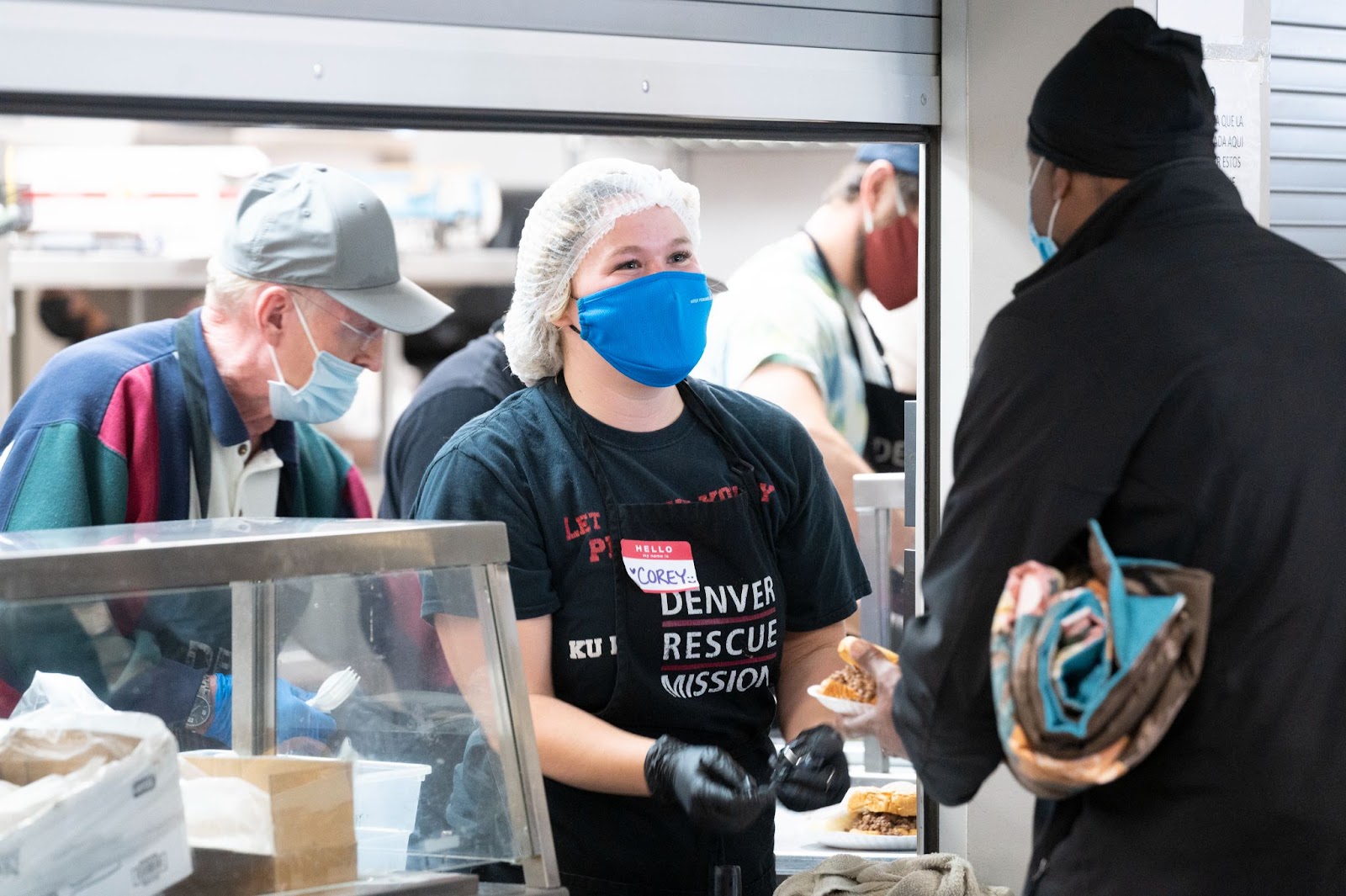
One of our partners, Denver Rescue Mission, has been a longtime food recipient of We Don’t Waste. The Mission has been at work since 1892 serving Denver’s homeless population, providing emergency services, rehabilitation, transitional programs, community outreach, and of course, warm meals!
“Being able to serve somebody food that you have poured your heart into is a special thing. The hope is that our meals provide a sense of dignity and respect to the people we serve; that’s what matters most.” – Denver Rescue Mission Chef
The relationship with food recovery is reciprocal as well. If there is food on-hand that Denver Rescue Mission does not need, they contact us, and we are able to redistribute the excess food to other organizations in the area.
Through this process, we are able to minimize the food that goes to waste and maximize the access to food in our community.
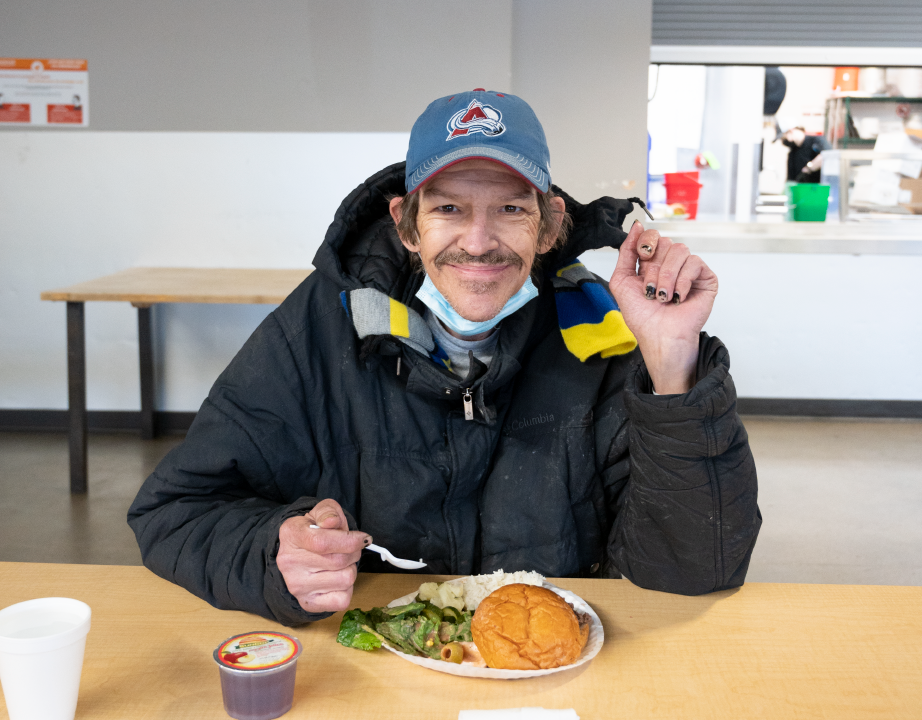
“The food is good and it feels good to come off the street and be acknowledged by goodhearted people.” – Denver Rescue Mission Guest
The food we provide to these communities is not just about ending the day with a full belly, but also regaining a sense of human dignity, belonging, and connection to their community. Good food provides the energy people need to pursue second chances and new opportunities and can help break the cycles of instability that come with experiencing homelessness. In some cases, these meals even save lives.
Denver Rescue Mission is now serving more than 815,000 meals a year! To put that in perspective, that’s over 2,200 meals a day. We are proud to partner with an organization that has provided integral support in our homeless community for over a century.
By being a member of the We Don’t Waste community, you are helping us provide food to over 90 nonprofit organizations like the Denver Rescue Mission, serving the most vulnerable members of our population. Our community is healthier, happier, and more hopeful because of these free meals — thank you for being a part of the movement to end food waste and food insecurity.
Today is International Women’s Day, and We Don’t Waste is celebrating our women on staff who #BreakTheBias every day! From managing incoming food donations, to driving the trucks to pick up excess food, to evaluating the organization’s impact on the community, we have some incredible women propelling We Don’t Waste as the largest food recovery-focused organization in Denver.
Starting with the leadership of the team, We Don’t Waste’s Director of Impact & Engagement, Allie. Her role involves assessing We Don’t Waste’s impact and figuring out how we can make a bigger and better impact (all while keeping the community at the center of our work).
“One way I work to #BreakTheBias at work is by simply being aware of unconscious biases and challenging preconceived ideas. Most of all, I think it’s important to listen and elevate voices and experiences that you may not notice if you’re not open to hearing from people.” – Allie
Programs and Educations Manager, Julia, conducting a food waste audit at a local elementary school.
Working with Allie to help engage and educate our community is Julia, our Programs and Education Manager. Julia is at the forefront of our education efforts, performing regular school presentations and food waste audits around the city, as well as putting together educational materials and making sure our Mobile Food Markets run each week without a hitch!
Those Mobile Food Markets are run each week in major part because of our volunteers, all of whom are led by our Volunteer Coordinator, Barona. She recruits, trains, leads, and coordinates the hundreds of annual volunteers that come through our doors both in the Distribution Center, and at our Markets. A fun fact about Barona: She is currently working on her carpentry skills, and just received her first toolbelt!
Kayleigh, a Food Recovery Specialist, is a part of our operations team that makes food recovery possible, and she also helps maintain partnerships with our nonprofit food recipients. Food Recovery Specialists are the most important members of our team, facilitating relationships with food donors, maintaining perfect food safety for pickups, and getting the excess food where it needs to go!
“I think I break the bias in my work life by being the only female Food Recovery Specialist on the team. Things like driving a truck, working a pallet jack, and operating a forklift tend to be thought of as more male-oriented jobs, but I do them all!” – Kayleigh
Next, we have Laura, who used to be a Food Recovery Specialist, but has moved over to our administrative side of the office as an Administrative Assistant. Now she focuses on a variety of tasks, “from Mobile Food Markets to grant research and school food audits, in addition to administrative tasks necessary to help keep the team organized!”
Nathan and Kayleigh delivering food on a pallet to a local nonprofit.
Grace, our Food Acquisition Specialist, works daily to bring new food donors on board with We Don’t Waste’s mission. There are countless opportunities to reduce food waste in Denver, and Grace helps find those opportunities and create new relationships! Without her work, we wouldn’t have as frequent and reliable pickups as we do.
Jessica, our Development & Events Coordinator, also works to develop We Don’t Waste’s reputation and relationship with the community. If you’ve attended a We Don’t Waste event, Jessica was behind the scenes, creating an incredible experience for everyone to enjoy. She also helps grow and integrate We Don’t Waste’s partners, donors, and sponsors into one large welcoming community!
Finally, there’s Caroline, our Communications & Marketing Coordinator. She is the one typing up We Don’t Waste’s emails, blogs, and social media posts and stays busy interacting with our community on a daily basis. If you’ve seen an illustration on a t-shirt or on our website, she’s also probably the one that drew it as well.
No matter where we are operating, there is a woman representing us and paving the way forward. We are proud to have such strong female representation in every aspect of We Don’t Waste’s mission.
Grace summed it up the best, “One of my favorite aspects of working at We Don’t Waste is collaborating with my female colleagues — each of whom is brilliant, creative and stands unwavering in her beliefs.”
It’s not a secret that the United States is a major creator of food loss and food waste. In fact, we discard more food than any other country in the world. There have been recent pushes to emphasize food waste as a major lever in reaching our climate goals, but the government can’t do it alone.
The U.S. Department of Agriculture and the Environmental Protection Agency created the U.S Food Loss and Waste Champions in 2015 to get private businesses on board with public commitments to reduce food waste in their U.S. facilities by 50% by 2030.
On February 22nd, they announced 7 new members that have promised to make the necessary changes to help protect our planet.
Danone North America, Albertson’s Company, BJ’s Wholesale Club, Smithfield Foods, Starbucks, Sysco, and Tyson Foods now join the ranks of over 30 companies that are making the commitment to reduce their food loss and waste.
From this point forward, these organizations will be included in the USDA and EPA’s quarterly reporting of the businesses’ progress towards their goals and the impact of their actions. By joining this group, these organizations will be held publicly accountable for their actions in reducing waste, and consumers can have the benefit of being more informed about the impacts of the companies they use.
Looking through the list, there are several popular methods corporations are now using to help reduce waste. Some are choosing to change their inventory management process, as well as their operations and supply chain processes to avoid food loss from excess at the source. Others are choosing to donate the excess foods to recovery organizations (like us!) across the nation to help feed both people and animals.
Commercial composting is being integrated for organic waste, and some corporations are also finding new ways to use byproducts. From reutilizing the scraps to create entirely new products, to creating more biodegradable byproducts, there are several ways many of these corporations are finding creative new solutions.
One notable mention would be the inclusion of Danone North America, the parent company of Two Good Yogurt, and an incredibly valuable partner of We Don’t Waste! For every cup of yogurt purchased, 2 cents is donated to We Don’t Waste, as well as City Harvest out of New York. Through this initiative, Two Good Yogurt is helping us recover hundreds of thousands of pounds of food each month! You can shop for some delicious yogurt to enjoy at several local grocers.
On top of Two Good’s donations, Danone North America is working to reduce waste on its operations and supply chain, in addition to ongoing efforts in its manufacturing facilities.
We are excited to see this list grow, and look forward to watching as new methods for reducing waste are created and implemented across all of the food industry.
And please, eat more Two Good yogurt – the environment (and We Don’t Waste) will thank you!
Everybody’s gotta eat – so why is it that when looking at the demographics of hunger in Colorado, the numbers for food insecurity and hunger across age, race/ethnicity, and locality differ so much?
Hunger and food insecurity are a result of hundreds of factors including but not limited to: debt, joblessness, sickness and hospitalization, lack of access to nutritious food, systemic disadvantage, and any combination of things that may make prioritizing food over other necessities a difficult choice.
We are going to look at some of the demographics of hunger in Colorado to better understand the groups at the highest risk of experiencing hunger and the factors that are causing this disparity.
The most recent survey for hunger by Hunger Free Colorado showed that in April 2021, about 29% of people who identified as white were experiencing food insecurity, but that number shoots up to 43% for those that are Non-white/Latinx.
Percentage of respondents who were food insecure Jan. – April 2021, based on the USDA 6-question food insecurity survey. Source: Hunger Free Colorado COVID Food Insecurity Survey, April 2021
A primary reason for the difference in food insecurity is the racial disparity in poverty in America, with the overall poverty rate in the US at 11.4% overall, but 19.5% in the Black community. When a household is already struggling to afford all their necessities, additional challenges, such as being furloughed during the pandemic, can often lead to those families sacrificing food first in order to continue to afford rent or medicine.
We also see this with longstanding, systemic issues for food access. When looking at a map of grocers that carry fresh produce, you may notice a pattern of stores clustered together in higher-income neighborhoods.
While there are many ways to define a food desert, the Healthy Food Financing Initiative (HFFI) Working Group considers a food desert as a “low-income census tract where a substantial number or share of residents has low access to a supermarket or large grocery store.”
This can be simplified to asking the question, is there a supermarket or large grocery store within 1 mile of my residence? For rural counties, this radius is extended to ten miles. If you answered no, chances are you are in an area considered a food desert. If you are in a mid-to-high level income area you are not in a food desert because you likely have a vehicle to drive the distance to the store at a cost insignificant to yourself.
The term food apartheid is often used in place of food desert, as supermarkets and grocery stores are strategically placed in areas with higher-income households. In Denver, an example would be the Globeville & Elyria-Swansea neighborhoods. Because this area has historically had more industry and less commercial development, it has remained a cheaper area to live in the city and has a higher population of low-income residents, thus remaining underserved in food resources.
Volunteers prepare bags of food to place in vehicles at a Mobile Food Market in September 2021.
Areas like this are also called food swamps, because of the high number of fast food, liquor, and convenience stores in place of supermarkets. Cheap and non-nutritious food is more accessible than fresh food, making it the reliable choice for families who can’t afford to travel farther for better food or don’t have access to transportation.
With the rate of poverty correlating to racial inequities in the country, it becomes clear how food resources become divided along racial lines as well.
What may come as a surprise, however, is that food insecurity is also different among age brackets. In Colorado, more than 50% of those under 44 reported experiencing food insecurity in April 2021. Those between the ages of 35 and 44 were hit the hardest, with food insecurity levels reaching a staggering 55%. The group least affected are those 65+, with only 5% experiencing food insecurity.
One of the largest factors affecting these age brackets is that many of these individuals are taking care of children. Among households with children, 30% of adults reported having to regularly cut back or skip meals because there wasn’t enough money to buy food, and 44% were unable to consistently put healthy food on the table.
So what about children? In Colorado, about 1 in 5 children are not getting adequate nutrition. These are record-breaking numbers for the state, with pre-pandemic numbers sitting at 1 in 9 children.
An even more shocking fact is that the National Summer Food Service Program reaches fewer than 1 in 10 children in Colorado in need. Many families are experiencing food insecurity during challenging economic times and aren’t accessing the resources they are qualified to receive.
Another key factor in food insecurity is where an individual lives. Prior to the pandemic, the numbers in 2019 showed that rural Coloradans were experiencing food insecurity at a rate of about 12% in comparison to urban Coloradans at 9.3%, and if you were between 19-25, rural Coloradans experienced food insecurity at 25.4%.
A child runs to her family at the Garden Place Academy Mobile Food Market in 2021.
If you look at any demographic, no matter age or race, if the individual lives in a rural area, the levels of food insecurity increase. For people living in rural areas, food insecurity is often attributed to less economic opportunity and transportation barriers, as well as less access to food resources like food pantries, community gardens, and more.
Most published surveys of hunger and food insecurity at the end of 2021 have been small-scale surveys, with more data covering the last half of 2021 expected in the next few months. The consequential COVID-19 variants and mandates may have affected these numbers, and the Great Resignation might change this narrative as well.
With all of this data, it is important to understand that hunger is tied to many socio-economic factors, and it looks different in every community across the United States. Not only that, but every community will have different solutions to combat these issues.
Our solution is to recover quality, unused food from the food industry and deliver it free of charge to food pantries, soup kitchens, schools, and shelters serving those in need. Our Mobile Food Markets serve our community directly with free food up to 8 times a month. By recovering food, we are tackling both food waste and food insecurity around Denver.
Get involved in helping your community and consider donating your time through our volunteering opportunities, supporting our mission, or becoming a part of our community online through our newsletter and social media!
When discussing food waste and larger sustainability concepts, there are often a lot of terms thrown around with no explanation as to where they came from or what they actually mean. For example, did you know that food loss and food waste are two completely separate concepts? Read on to equip yourself with the knowledge you need to have a productive conversation that everyone can understand!
Carbon Footprint
A carbon footprint is a measure of the impact human activities (as an individual, event, place, or organization) have on the environment based on carbon outputs (including both carbon dioxide and methane).
Carbon Neutral
Carbon neutral means making no net release of carbon dioxide to the atmosphere by producing emissions equivalent to the amount sequestered by carbon sinks (anything that absorbs more carbon from the atmosphere than it releases). This is commonly achieved by offsetting emissions through planting trees.
Carbon Sequestration
Carbon sequestration is the process of capturing and storing atmospheric carbon dioxide in plants, soils, geologic formations, and the ocean. It is a natural process (think trees) and one of the most effective ways to reduce the greenhouse effect.
Circular Economy
An economy that uses a systems-focused approach and involves industrial processes and economic activities that are restorative or regenerative by design is a circular economy. You will often see this phrase in the context of recycling programs or regenerative farming.
Climate Change
Climate change is a long-term change in the average weather patterns that have come to define Earth’s local, regional and global climates. This term often replaces “global warming,” as it more accurately describes the phenomenon.
Cradle to Cradle
If you were to buy a reusable water bottle, use it for 5 years, and then recycle it to be used to create a new water bottle, you’ve participated in a cradle to cradle system. It is a biomimetic approach to the design of products and systems that models human industry on nature’s processes. It sees garbage as an eternal resource and promotes doing the right thing from the beginning.
Ecological Footprint
The impact of a person or community on the environment expressed as the amount of land required to sustain their use of natural resources is the ecological footprint. Denver’s ecological footprint includes all of the surrounding land used for agriculture and ranching to feed our population.
Ecological Restoration
Ecological restoration is the process of repairing sites in nature whose biological communities (that is, interacting groups of various species in a common location) and ecosystems have been degraded or destroyed.
Environmental, Social, And Governance (ESG)
The ESG is a set of standards for a company’s operations that socially conscious investors and consumers use to screen the company’s sustainability. Environmental criteria consider how a company performs as a steward of nature. Social criteria examine how it manages ethical relationships with employees, suppliers, customers, and the communities where it operates. Governance deals with a company’s leadership, executive pay, audits, internal controls, and shareholder rights.
Food Security (Food Insecurity)
Food security is the state of having reliable access to a sufficient quantity of affordable, nutritious food. Food insecurity thus means the opposite, having unreliable access.
Food Systems
Food systems encompass the entire range of interlinked activities involved in the production, aggregation, processing, distribution, consumption and disposal of food products that originate from agriculture, forestry or fisheries, and parts of the broader economic, societal and natural environments in which they are embedded.
Food Loss
Food Loss refers to food that gets spilled, spoiled or otherwise lost at production, post-harvest, processing, and distribution stages in the food supply chain. Loss happens before consumers have access to food.
Food Waste
Food waste refers to food that completes the food supply chain (referred to as the retail and consumption stages), of good quality and fit for consumption, but still doesn’t get consumed because it is discarded, left to spoil, or expired. Up to 60% of food loss and waste occurs in consumer’s homes.
Greenwashing
Greenwashing is the process of conveying a false impression or providing misleading information about how a company’s products, services, or practices are more environmentally sound.
Organic Waste
Organic waste is any material that is biodegradable and comes from either a plant or an animal. Biodegradable waste is organic material that can be broken down into smaller parts, making it an essential component of composting.
Social Enterprise
A social enterprise or social business is defined as a business with specific social objectives that serve its primary purpose. Social enterprises seek to maximize profits while maximizing benefits to society and the environment, and the profits are principally used to fund social programs. Think of Tom’s shoes donating a pair of shoes for every pair sold.
Sustainable Development Goals (SDG)
The Sustainable Development Goals (commonly shortened to SDG) are a set of interlinked global goals designed to be a universal call to action to end poverty, protect the planet, and ensure that by 2030 all people enjoy peace and prosperity. The SDGs were set up in 2015 by the United Nations General Assembly and are intended to be achieved by the year 2030.
Sustainable Food System
A sustainable food system is a food system that delivers food security and nutrition for all in such a way that the economic, social and environmental bases to generate food security and nutrition for future generations are not compromised.
Supply Chain
In the context of food waste, the supply chain refers to the production, post-harvest, processing, distribution, retail, and consumption stages of food.
Zero Waste
Designing and managing products and processes to reduce the volume of waste and conserve or recover all resources so no trash is sent to landfills, incinerators, or the ocean.
Now that you are an expert on all things food waste, keep the conversation going on social media and share what you learned with the world!
If 2020 was one of the most unexpected years in recent history, 2021 comes in second place! We’ve all become used to expecting the unexpected as COVID continues to challenge our community. Food insecurity is still sitting at an all-time high of 1 in 3 Coloradans. But stay with us, there is good news too! As hunger has increased, so has We Don’t Waste’s capacity.
With so many more people experiencing food insecurity, the first solution we had to tackle was to increase our food output. Most of the food we recover is distributed through partner organizations. These organizations serve a wide variety of communities ranging from elementary schools, veterans, young families, those experiencing homelessness, and more. By providing these organizations with reliable, free food resources, they are able to provide quality food to their communities while dedicating less of their annual budgets towards food expenditures. Less money spent on food means more spent on programming and other resources.
Our partners aren’t the only way we distribute food! We have 6 to 8 Mobile Food Markets in a typical month. In total, we ran 71 markets this year. These markets served over 50,000 individuals, 40% of whom were children. We were also able to re-introduce the much-loved Garden Place walk-up market to the excitement of the surrounding community!
We pride ourselves on the variety of foods we are able to provide to both our market participants and our distribution partners. Over 50% of foods recovered were fresh (protein, fruits, veggies, and dairy).
Overall, it was an incredible year of growth for our Mobile Food Markets and our distribution network. How were we able to feed so many people? We expanded our vehicle fleet by 1 van, and our staff by 5 people (making us less small, but still mighty)! We are more mobile than ever! From small pick-ups, increased recovery of frozen foods (thanks to our new walk-in freezer), and new food donor relationships, we are able to recover foods with more efficiency than ever before!
We couldn’t have done all of this alone. Over the last year, we had over 755 people volunteer with us! With over 4,785 hours of volunteering served over the course of the full year––our community really pulled their weight!
We also stayed busy educating youth all across the Denver metro area about food waste and what they can do to prevent it. The enthusiasm we have seen during these presentations definitely makes us hopeful for the future!
It wasn’t all work though, we got to have some fun with everyone at several events!
Our 12th Fill A Plate For Hunger was held in September and we had the privilege of enjoying live music, incredible food, and an exciting auction! We received an immense amount of support from the attendees, sponsors, and local chefs in attendance and can’t wait to do it again next year!
Canstruction® made its triumphant return to Colorado and was on display November through early December at Stanley Marketplace! We had several larger-than-life structures made entirely out of canned food from local architecture and engineering firms (in addition to two bonus structures designed and built by our very own IT & Database Administrator, Mario)! Huge congrats to the winner of the People’s Choice Award, W.E. O’Neil Construction Co. of Colorado with their CANorado Grill design.
Towards the end of the year, we celebrated a staggering amount of generosity from our community! Giving Tuesday and Colorado Gives Day were just a week apart at the end of November, and we were stunned by the support! Thousands of donors showed up to effect change and showed a record-breaking level of support.
In total, $76,000 was donated over a 24-hour period alone! To put that in perspective, that will result in around 518,000 more meals of recovered food! That equals roughly 1,500,000 servings of food representing 11,000 tons of greenhouse gases prevented.
It was a strong way to end the year, and motivates us to make next year even better!
Thank you for joining us on the wild ride that was 2021! The amount of support we received stuns us every day.
As a part of this community, serving the community, we feel deeply indebted to everyone for their help and support, and we look forward to a day where hunger is drastically reduced, food ends up on plates, and Colorado is a happier, healthier home for all!