Boo! Is there anything spookier than food waste? We don’t think so. That’s why we’ve compiled some ways to make your upcoming Halloween celebrations more sustainable and waste-free!
Use a reusable bag for your trick-or-treating! The classic pillowcase has never gone out of style and can fit a massive amount of candy.
Use eco-friendly alternatives to treats. Use bulk candy in cardboard or cloth reusable bags for your friends. As for the neighborhood kids, individually wrapped candy is definitely the safer way to share food with strangers, but throw in other 10-cent treats like pencils, temporary tattoos, and more if you don’t want to buy the large plastic bags of candy full of many smaller plastic bags!
Don’t recycle candy wrappers. Most recycling plants do not accept the plastic wrap and will have to turn away massive loads of recycling if too much of the load isn’t recyclable. It’s best just to put these in the trash to ensure your recycling is actually recycled.
But keep your aluminum! Aluminum foil covering like on Hershey’s kisses can be recycled if clean and clumped into a larger ball. Keep combining the aluminum foil with more aluminum products until it’s about the size of your fist, and it’s good to recycle.
Hosting a party? Save the leftovers and compost the rest. Those trays and trays of spooky treats you made shouldn’t go to waste! Send people home with leftovers, or compost the remaining ghoulish greens.
Use compostable silverware and cups! It will make the clean-up easier, and you don’t have to throw away more plastic.
Prepare for the pumpkin-pocolypse! About 1.3 billion pounds of pumpkins end up in the trash at the start of November (which creates a HUGE amount of methane). Here are 46 pumpkin-centric recipes that you can try to use up the remaining pumpkins after the festivities. And don’t forget, compost what you don’t eat (but only if they aren’t painted, acrylic paint doesn’t decompose well). The graveyard of pumpkins will eventually break down into a nutritious treat for your garden or someone else’s if your city has a composting program.
Thrift your costume! Most costumes now are made with a lot of plastic fabrics, and despite costing an arm and a leg, you probably don’t want to wear the costume more than once. Get more bang for your buck by using your creativity and thrifting pieces for your costume.
To build on the last point, donate your costume! You may have worn it three times in one weekend, but your costume will be brand new to someone else.
Today September 28th, the White House will gather with hundreds of advocates, educators, health care professionals, lawmakers, cabinet officials and everyday Americans to discuss the state of hunger and food security in the U.S. This conference aims to identify the solutions to hunger and nutrition-related diseases and create clear courses of action on a systemic level and an individual level.
The hope is that the focus on these issues will be transformational for the systems in place currently, and can lead to the addition of entirely new programs. The first conference that took place over 50 years ago led to the creation of the first major underpinnings of hunger-relief programs that still run today, including:
Significant expansion of the National School Lunch Program and the Food Stamp Program (known today as the Supplemental Nutrition Assistance Program, or SNAP),
Permanent authorization of the School Breakfast Program,
Launch of a pilot program that would later become the Special Supplemental Nutrition Program for Women, Infants, and Children (WIC), and
The first ever Dietary Guidelines for Americans.
These programs quickly became integral resources for Americans. Over the last 50 years, our federal nutrition assistance programs have grown to serve about one in four Americans each year. For so many Americans, balancing the increasing costs of food, rent (we’re looking at you, Colorado) and utilities leave little room for savings or emergencies when wages remain slower to grow.
This conference comes after one of the biggest jumps for food costs in one month, with food prices rising 13.5% year-over-year in August according to the Consumer Price Index (CPI), the largest 12-month increase since 1979, according to the Bureau of Labor Statistics.
Recently, the free school lunch program ended across the country, leaving millions of families scrambling to rearrange their budget to cover their children’s additional meals each week. Some 330,000 students, or 37% of total enrollment, were eligible for free or reduced school meals in 2021 across the state.
This November, the Healthy School Meals For All policy goes up for vote in Colorado. This would reinstate the free school lunch program, and make nutritious meals available to every growing child in our state. Ashley Wheeland, public policy director for Hunger Free Colorado, estimates the program would save struggling Colorado families $78 million a year. Those savings in turn can help them keep up with bills and other needs. With the expiration of the child tax credit and other pandemic-era help, the help is even more desperately needed, she said.
Hunger rates also rose this summer when supply chain interruptions began to impact local grocers. Food insecurity for families with children climbed to 16.21% by July 11, when nearly 1 in 6 families reported sometimes or often not having enough to eat, according to the U.S. Census Bureau’s Household Pulse Survey, the highest since December 2020.
Escalating food prices are eroding the reach of SNAP dollars, which average around $231 per person per month in 2022, according to USDA data, sending more people to food pantries, which are in turn receiving less food from the government. In August 2022, the agency announced a cost-of-living adjustment beginning Oct. 1, increasing maximum monthly SNAP allotments for a family of four from $835 to $939 a month.
So there are a lot of moving pieces, but where does this leave food banks, food recovery agencies, and more? Supply chain issues are still causing issues in stocking our grocery stores, leaving costs inflated and less food available for recovery. And it’s not just individuals who are feeling the squeeze, as food pantries and other hunger-fighting organizations are also spending more on their grocery bill each week.
If you would like to help, please consider supporting We Don’t Waste. Our vision is that nutritious food will be accessible to all, and with your support, we can make it happen. Let’s do this!
Get involved as a volunteer, and see the impact your time can make on your community. Donate once or give monthly, and you can help us provide countless meals to our neighbors.
If you can’t prepare your veggies before they spoil, try blanching them to freeze them in time! What is blanching? It’s the process of rapidly heating and cooling fresh foods to prep them for extended stays in your freezer.
The benefits of blanching food, instead of just throwing it in the freezer, are numerous! The process helps prevent enzyme breakdown, preserving the flavor and texture of the fruits and veggies you love. In addition, it cleans and disinfects the food by killing microorganisms on the surface to keep the food fresher, longer. Most importantly, it also helps keep the nutritious value of the food intact and prevents the breakdown of essential vitamins and minerals we love in our veggies.
So what can you blanche? Pretty much any vegetable will benefit from the blanching process. Tender leaves will wilt while blanching, and some vegetables (broccoli, asparagus) will soften, but don’t worry, they will perk right up after thawing and cooking.
It is a delicate process but gets easier with practice. Under-blanching stimulates enzyme activity (which defeats the purpose of blanching), while over-blanching leads to partial cooking and causes loss of flavor, color, vitamins, and minerals.
The best thing to do is to follow the instructions below, and pay close attention to the time the vegetable spends being blanched. By keeping an eye on the timer you can prevent both under-blanching or cooking the food!
Try it out using these instructions:
Use a blancher with a blanching basket, fry basket, or a strainer (be sure to use oven mitts if you don’t have a handle to use), or fit a wire basket into a large pot with a lid.
Use one gallon of water per pound of prepared vegetables.
Put vegetable in blanching basket and lower into vigorously boiling water. Place lid on blancher. The water should return to boiling within 1 minute, (if it doesn’t, too much vegetable is being used for the amount of boiling water).
Start counting blanching time as soon as the water returns to a boil.
Keep heat high for the time given in the directions for the vegetable you are freezing.
Immediately plunge basket of vegetables into a large quantity of cold water, 60ºF or below.
Change water frequently or use cold running water or ice water. If ice is used, about one pound of ice for each pound of vegetable is needed.
Cooling vegetables should take the same amount of time as blanching.
Drain vegetables thoroughly after cooling. Extra moisture can cause loss of quality when vegetables are frozen.
To steam blanch the vegetables, simply keep them above the boiling water instead of submerging them by using a taller pot. Check out the graphic below to see some example times for some commonly used vegetables that are easy to blanch!
Blanching your vegetables before freezing them is not always necessary, but it can help extend shelf life, flavor and texture! The most important thing to remember is just to use up as much food as you can. The less food that ends up in the trash can, the less money you’ve wasted on uneaten groceries, and the less carbon impact is created by food waste! There are lots of other ways to reduce waste in your kitchen. Check out How to Reduce Waste with Kids and our Top 10 Ways to Improve Food Storage. Are you curious about how much food waste you are actually producing at home? Check out We Don’t Waste’s At-Home Food Waste Audit and see what foods are commonly going to waste in your kitchen!
Last year, we shared our seven essential reads on food systems covering many different aspects of food systems and food cultures. This year we have an updated collection of books for you to add to your summer reading list! Whether you’re interested in growing food, cooking it, eating it, or just learning more about food and all of the many ways it plays into our lives, we’ve got something for you!
Retail Inequality by Kenneth H. Kolb
We Don’t Waste in the business of making sure everyone, no matter their background, has equal access to nutritious food. For us, that means we provide free food to communities across Denver in areas considered to be “food deserts” or “food apartheids.” These are neighborhoods that lack multiple options for affordable, nutritious food. “Food apartheid” addresses the nature of intentional scarcity by the strategic placement of retail stores and whole-food markets in wealthy neighborhoods. Kolb takes a deep dive into two neighborhoods in Greenville, South Carolina, that have spent decades without access to nutritious food, and how the retail and food industry, and even public policy, contribute to the unequal access present in these communities.
Foodtopia by Margot Anne Kelley
Food isn’t just about nutrition and survival, but is also intrinsically tied to our lifestyle. Throughout America’s industrial and capitalistic history, there have continually been surges of the “back of the yard” counterculture movement. Through gardens, homesteads, and moving out to land far from the city centers, Kelley covers 5 groups—from the 1840s up through the COVID-19 pandemic—that have taken food production into their own hands in a form of radical self-sustenance. Fueled by the drive for furthering the sustainability of our land and water resources, racial equity, anti-consumerism, and control of their health through food, these groups found independence and their own “Foodtopias” in their backyard.
To Boldly Grow byTamar Haspel
Part memoir and part how-to guide, self-proclaimed “crappy gardener” Haspel shares the story of how she and her husband decided to reclaim their diets by growing their own food, keeping chickens, fishing, and even going out into the woods to forage for mushrooms, root bulbs, and anything else they find that is edible! Haspel’s goal is to prove that going out and making food or finding it ourselves really isn’t as difficult as it’s made out to be, as she shared her stories of triumph in MacGyvering harvesting tools, and by sharing the spectacular failures that ruined Thanksgiving dinner. In the end, Haspel discovers how the way we interact with and consume our food can change the way we think about our food—and even ourselves.
Getting Something to Eat in Jackson by Joseph C. Edwoozie, Jr.
Edwoozie, Jr. takes a deep dive into the way “foodways”—food availability, choice, and consumption—are changing in Jackson, Mississippi, and how the changing culture surrounding race is impacting food culture, and vice versa. Historically, food in Jackson had been a unifying force for Black Jacksonians in Mississippi, but as Edwoozie, Jr. discovers, the way people consume food has changed because of the existence of food deserts, the perception and reality of class differences, and how vegetarianism and veganism as a way to address health outcomes have all but displaced the traditional culture of “soul food” in the urban south. Edwoozie, Jr. spends a year following a diverse socioeconomic array of Jacksonians and discovers the habits and trends of the modern food culture and how it reflects societal changes in the area.
I Am From Here by Viswath Bhatt
There are few things more comforting than a home-cooked meal, and for Bhatt, this would be a combination of American Southern food and traditional Indian cuisine. Bhatt has been the executive chef of the Snackbar in Oxford, Mississippi since 2009, earning him Best Chef: South (2019 James Beard Awards) and induction into the Fellowship of Southern Farmers, Artisans, and Chefs in 2022. This collection of stories and instruction includes over 130 recipes inviting you to grill, fry, and boil your way into a more delicious dinner evoking the flavors of an evolving southern cuisine.
What Your Food Ate by David R. Montgomery and Anne Biklé
When you think of the quality and the health benefits of the meat you eat, you’re also probably thinking about the things that animal was eating while it was alive. Montgomery and Bilke argue that the same standard should be applied to the plants we eat as well! Combining multiple scientific disciplines and weaving them into one cohesive story, Montgomery and Bilke show how the health of our soil has a direct impact on the quality of the food we consume and the health of humans as a whole. Can we produce enough quantity and quality food? We’ve got to heal the sick soil to do that, and the results of this could help reverse the modern epidemic of chronic diseases and mitigate climate change.
The Regenerative Garden by Stephanie Rose
Discover how you can work with nature, as opposed to against it, by employing permaculture techniques in your garden. Through 80 different DIY projects, you can explore how to make your garden more eco-conscious and more resilient. Whether you’re working with an acre, a small raised bed, growing a grove of trees, or a single tomato plant, there are plenty of tricks and habits for you to implement to make permaculture accessible and working hard for your garden.
Iwigara by Enrique Salmón
The belief that all life-forms are interconnected and share the same breath—known in the Rarámuri tribe as iwígara—has resulted in a treasury of knowledge about the natural world, passed down for millennia by native cultures. Ethnobotanist Enrique Salmón builds on this concept of connection and highlights 80 plants revered by North America’s indigenous peoples. Salmón teaches us the ways plants are used as food and medicine, the details of their identification and harvest, and their important health benefits, plus their role in traditional stories and myths.
How We Eat by Paco Underhill
In this upbeat and witty approach, How We Eat reveals the future of food in surprising ways. Go to the heart of New York City, where a popular farmer’s market signifies how the city is getting country-fied, or to cool Brooklyn neighborhoods with rooftop farms. Explore the dreaded supermarket parking lot as the hub of innovation for grocery stores’ futures, or how marijuana farmers, who have been using artificial light to grow a crop for years, have developed a playbook on indoor farming for mainstream merchants like Walmart and farmers across the world. In How We Eat, Underhill shows how food intersects with every major battle we face today, from political and environmental to economic and racial, and invites you to the market to discover more.
Recovered food is sourced from countless businesses, and is donated for equally as many reasons. Some food comes from the excess that is produced intentionally to cover customer satisfaction in the event of an exchange or return. Other food items get caught in traffic during transit and arrive too late for grocers to meet the “sell-by” date. What is common across the country and throughout the entire food industry is the immense amount of food that never makes it to people’s dinner plates.
The Bill Emerson Good Samaritan Food Donation Act was passed in 1996 to shield food donors from criminal and civil liability, and as a result, encourage more food donations. The burden of food safety is transferred to the nonprofits and organizations receiving the food, and businesses are free to decide what food they donate.
It seems counterintuitive, but the Act is regularly cited by businesses as the reason they choose not to donate food. Something has to change when the Act that is meant to protect donors becomes a confusing and discouraging hurdle.
This is where the new, proposed Food Donation Improvement Act comes into play. It would update the 1996 Act, making it easier for people to donate food and to feel more comfortable with the process. The current Act does not have a specific agency in charge of clarifying the details, nor does it explicitly address many of the common circumstances in which a business or farm might donate food. Many business owners find the vague language concerning, and don’t have an immediate or official source of guidance.
The update would require the USDA to release regulations clarifying the protections that exist, the businesses and agencies that can donate, and which businesses (nonprofits, schools, food banks, etc.) they can donate food to.
In addition to the clarification, it would also extend liability protection to food businesses and farms that want to donate food directly to people in need without going through a registered nonprofit. A restaurant shut down by the pandemic that wants to serve community meals would be protected, as would a school that wants to send surplus food from meal programs home with low-income families. Finally, it would also cover organizations and companies that want to take surplus food and sell it at a very low cost—such as nonprofit grocery stores that accept donations.
The response to the Food Donation Improvement Act has been overwhelmingly positive from lawmakers and policy experts, with the sentiment being that making food donation easier is just common sense. It is a straightforward way to reduce greenhouse gas emissions on a national scale and will increase food access as well.
And while activists acknowledge that the bill alone will not solve hunger, it represents an important step in reducing food insecurity and protecting the environment. Chef and advocate Tom Colicchio also argues that preventing food waste is a matter of showing respect for the food that nourishes eaters and the workers who produce it. By wasting food, he says, “we’re devaluing not just the food, but we’re devaluing the people who are responsible for feeding us.”
We Don’t Waste has signed the petition in support of this act, as it directly aligns with our goal of using food recovery and distribution as a means to support our environment and increase food access in our communities. To learn more and support this initiative, sign the petition here.
It’s Pride Month—a time to celebrate the diversity in Denver and the richness it brings to our community! But, while we celebrate, it is also important to reflect on the inequities in the present that we can work to solve. Though LGBTQ Americans have seen rapid advancements in both societal acceptance and civil rights protections in recent years, food insecurity continues to affect the community at higher rates than the general population.
In 2021, (for the first time ever!) the U.S. Census Bureau asked about sexual orientation and gender identity in the Household Pulse Survey. This survey was sent to measure different social and economic experiences of U.S. households throughout the pandemic, and as a result, can compare the experiences of LGBTQ adults with other groups.
Of the more than 64,000 people who responded to the bureau’s latest Household Pulse Survey, over 13% of LGBTQ adults reported living in a household that experienced food insecurity in the past seven days, compared to 7.2% of non-LGBTQ adults. If there was any uncertainty about a discrepancy in the demographics, there is none now.
The survey also revealed the extent to which many LGBTQ Americans are struggling with economic insecurity. According to the results, 36.6% of LGBTQ adults reported living in a household that struggled to pay for expenses in the past seven days, with over 8% saying they were not confident they could afford to make their next housing payment on time. By comparison, just over one-quarter of adults who do not identify as LGBTQ reported experiencing economic insecurity.
A recent Gallup survey shows that 5.6% of the American population currently identifies as LGBTQ. The problem is not insignificant.
Fortunately, there are lots of organizations in Denver working to support LGBTQ youth and adults. Some of the larger organizations like The Center on Colfax and One Colorado are working to support the community through a long list of programs and free resources from mental health to legal representation.
There are a few organizations We Don’t Waste works with directly that help fight food insecurity in the LGBT community as well. We provide food to the Colorado AIDS Project as a part of the Colorado Health Network, and The Delores Project, which provides shelter to women and transgender individuals experiencing homelessness. We Don’t Waste began working with the The Delores Project in 2011 and has been delivering food to support their food programs on-and-off since.
“What began as a winter-only shelter has now morphed into a robust 24/7 low-barrier, housing-focused 50-bed shelter with rehousing case management and wrap-around support. Our team embraces a housing-first model of care, working to get individuals out of the shelter system and into housing as quickly and safely as possible while providing the necessary support before, during, and after the transition into housing,” says Stephanie Miller, CEO of The Delores Project.
Being a 24/7 shelter means providing regular food to their program participants, and lots of it! The Delores Project serves three meals and two snacks a day to their residents alongside many other essential services. Food program costs can be a massive financial burden for nonprofit organizations, especially with rising grocery costs due to recent inflation rates. Fortunately for The Delores Project, they receive some help from the community.
Volunteers serving tacos for dinner during a Taco Tuesday event.
“About 52% of the meals served in our shelter is donated,” Stephanie says. A few thousand pounds of that each month comes as a recovered food from We Don’t Waste!
In addition to the meals, they offer a food pantry for their residents in shelter and those transitioning out of shelter and into permanent housing. It’s just one of the many ways they help create longterm solutions for the women, seniors, and transgender adults that seek support through their programs. Through free shelter, meals, mental-health education, and transitional housing programs, The Delores Project has created a system that allows for dozens of adults each year to transition from homelessness into stable and secure independence.
The shared dining hall for the residents of The Delores Project.
One of the ways We Don’t Waste is unique as an organization is our network of nonprofit partners, through which we are able to distribute millions of servings of food each month. Through our connection with The Delores Project, we are able to contribute to hundreds of free, nutritious meals each month for transgender and gender-expansive people in an environment where they can thrive in a community of specialized support.
Eco-anxiety, climate change anxiety, environmental paralysis. It goes by many names but can be described as the overwhelming feeling of stress and despair you get when you consider the environmental damage done by humans in the last century. It’s a complex feeling, and can be a different experience from person to person.
You’re browsing the news and you see that another species has gone extinct, or a photo of our oceans full of plastic. This can inspire feelings of guilt, stress, anxiety, or even grief. It is concerning, and you should respond with concern to news like this because you care about the future of our planet; that said, it is important to re-center ourselves, and not let the despair prevent us from taking action.
After all, there is more news coming out and studies published every day that show that many environmental problems are reversible, and with some effort, we have seen some pretty major environmental impacts out of efforts made around the world.
So what do we do to get over that feeling?
Do something about it!
It can feel impossible to make an impact when a lot of the damage is being done by multinational corporations, but there are ways you can make a major difference in your own neighborhood! Action is the best way to get over the feeling of hopelessness. Volunteer with a local organization working to make a change in your backyard! We Don’t Waste works to support our local environment by preventing as much food from going to our landfills as possible (which prevents highly volatile methane emissions). DUG and RE:Vision both allow you to participate in local community gardens and create free food for those in need.
Take a break from the news.
It can be hard to escape bad news when it seems to be the only kind of news presented to us on a daily basis. Try to go a day or two without looking at the news. Unless your job requires you to stay up to date on everything the minute it’s happening, you won’t be too out of the loop by giving yourself a short break. In fact, studies show that we often consume too much media, which causes our nervous system to be overloaded with information and can lead to increased stress and anxiety in our daily lives.
Osyter mushrooms are capable of decomposing plastic, and they’re edible!
Focus on the GOOD
Believe it or not, there are countless groups working around the clock, all over the world, that are making a difference every day! There have been incredible innovations in green technology, more global political support, greater importance placed on systemic issues, and measures being taken to protect the most at-risk and important ecology. Did you know that there is a species of fungi that can eat and decompose plastic? And there are kelp forests being planted in the ocean to absorb atmospheric carbon and sink it deep into the ocean where it can be consumed by fish and completely removed from the cycle. How cool is that!
If podcasts are your thing, the Intersectional Environmentalist runs a podcast, The Joy Report, that focuses on news in climate solutions and environmental justice, but exclusively from an optimistic and joyful perspective!
Let the feelings out, and let others know
You are not the only person experiencing these feelings. As more and more people become aware of the importance and the severity of climate change, more are experiencing eco-anxiety. In the first tip, we mentioned volunteering with local environmentally-based nonprofits. These can be a great way to connect you with other people working to heal our planet. There are also lots of clubs and groups that meet virtually and in-person that can offer you some support. Look for Facebook groups in your area focused on conservation efforts, or organizations supporting political action in your local government.
Produce bags can help reduce plastic usage with each grocery trip.
Make sustainable changes at home
Sometimes even the smallest changes in your daily routine can lead to a larger personal impact, and can help reduce those feelings of helplessness over time. You can reduce your single-use plastic by swapping out products you currently use with others using more sustainable packaging like recycled cardboard or glass. Buy fruits and vegetables that aren’t packaged in plastic, and use your own produce bags when you shop.
It can be small changes like setting a timer for your showers or something as large as installing solar panels on your home. Everyone has access to different solutions, and what you can incorporate into your lifestyle will be different from your neighbor. Just figure out what makes sense for you, and don’t try to change everything at once! Not only will it feel good to make these changes in your life, but you’re voting with your dollar, a powerful tool for change.
Learn more about climate solutions
By better understanding the issues surrounding climate change and environmentalism, you won’t fall prey to the dramaticized and melodramatic news stories meant to make you click on an article out of fear and confusion. It can also help you feel more connected to the planet, and inspire feelings of wonder and admiration for the planet we live on.
Braiding Sweetgrass by Robin Wall Kimmerer is an excellent example of compassion and appreciation for nature from an indigenous lens, and one that sees plants as our partners on the planet, not as tools.
How to Be a Climate Optimist by Chris Turner covers a dozen climate-related projects around the world, all working to save our planet with innovative technology and proactive communities.
There are many ways to consider eco-anxiety and how it may play a role in our sustainability journey. Remember to validate your concerns without dismissing your power to drive change. Feel your feelings and let them motivate you to take action. Eco-anxiety may be a familiar or foreign feeling to you, but regardless, we have many opportunities to healthily manage our emotions and transform our worries into meaningful action.
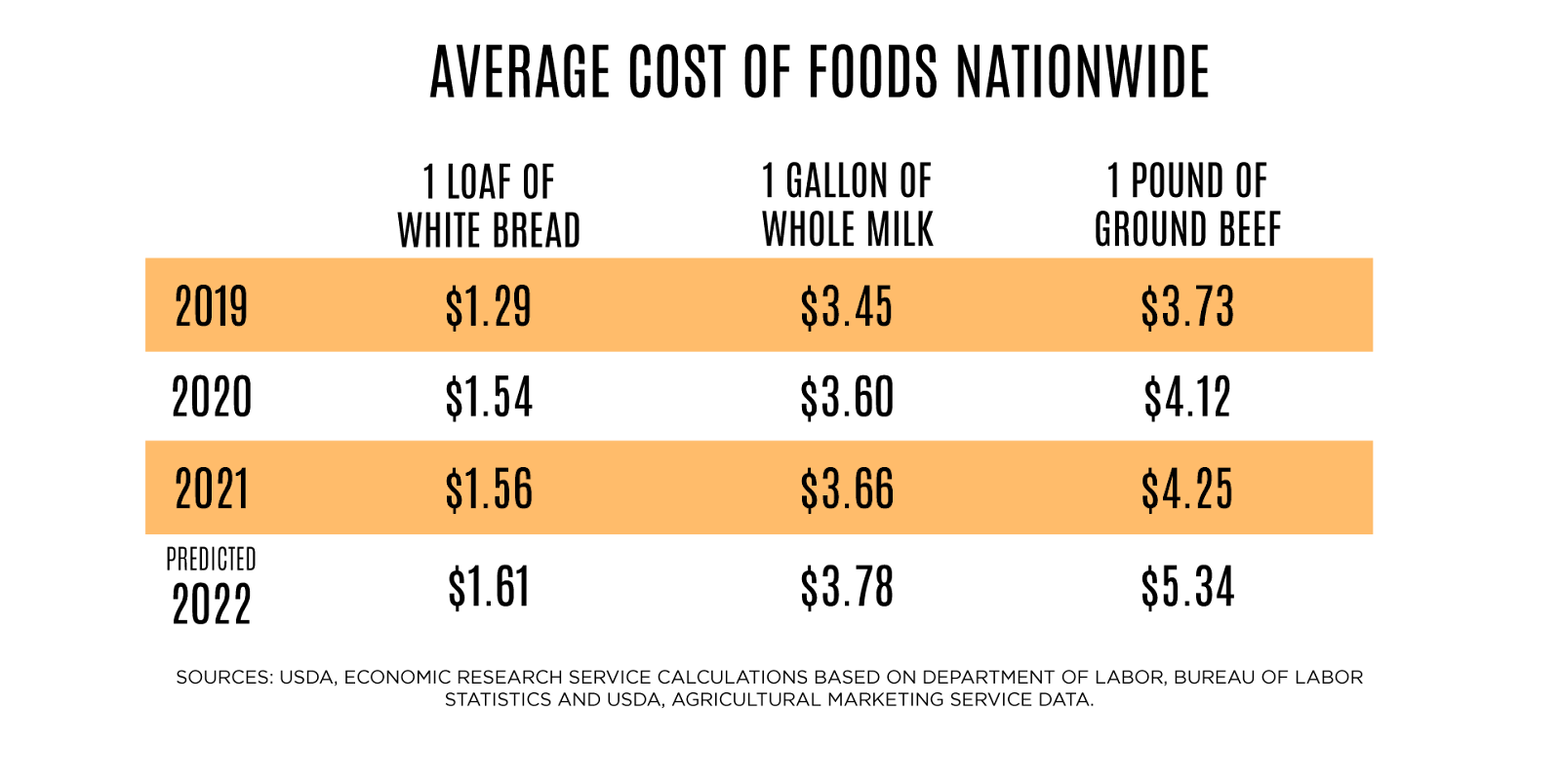
It’s not your imagination: your grocery bill has gone up and food prices have risen substantially. Many Americans are feeling the squeeze of the increased costs as food prices continue to rise and food budgets are stretched to their limits.
Since the initial pandemic shutdowns in 2020, food systems globally and nationwide have struggled to adapt to disrupted production and delayed distribution. In addition to all of this, the invasion of Ukraine and subsequent international sanctions on Russia mean that some of the top wheat producers are exporting a fraction of what they used to.
Let’s take a look at some of the consequences of these events on the U.S. food system up close.
In 2020, food-at-home (food you purchase at a grocery store) increased in cost across all food categories by 3.5% on average. The biggest increases in cost were beef and veal, pork, and poultry, increasing at 9.6%, 6.3% and 5.6% in cost, respectively.
This trend continued in 2021 with food prices again increasing at 3.5% on average across all food categories. Not a single category of food decreased in cost, but it’s a good time to be vegetarian! The largest difference was again beef, at a 9.3% increase. The smallest change was fresh vegetables at a 1.1% increase.
Does it get any better in 2022? Most likely not. Looking at the current prices and food trends, the ERS predicts that food prices will still continue to rise at a similar rate in every category. The conflict in Ukraine has placed international pressure on wheat production, with farm-level wheat prices now predicted to increase between 40 and 43 percent and wholesale wheat flour prices predicted to increase between 21 and 24 percent in 2022.
What does this mean for families dealing with food insecurity? It’s not great. The average SNAP recipient in the U.S. receives $239 per month for a household of two. That means one person is getting less than $30 a week.
Let’s say you bring home 2 pounds of ground beef, marinara sauce, two boxes of spaghetti, a packet of deli meat, a loaf of bread, two heads of lettuce, generic cereal, and a gallon of milk. Most Americans will have maxed out their SNAP budget with that much in their grocery cart, and it’s not enough. According to the USDA’s data, the average household of two individuals between the ages of 14 to 71 spent roughly $483 on groceries in March 2022. And that doesn’t include the toiletry purchases everyone makes each trip.
Inflation is expected to continue for a number of reasons. Ukraine and Russia produce about 30% of the world’s wheat, wheat flower, and sunflower oil, and with exports limited, the costs for these bulk items are soaring. Many products containing these ingredients are experiencing an uptick in price, and this also leads to a cost increase for animal products, as the feed these animals consume goes up in cost. To top it all off, increasing fuel prices make food transportation more costly, and the consumer ends up seeing this cost reflected in the cost of goods as well.
That was a lot. What do we do now, knowing that grocery prices will likely just continue to increase? Aside from the common answer of sharpening your couponing skills, it’s important to use what you have! We have a list of tips for keeping food fresh and delicious on our Education page. We have blogs on reducing waste with children at home, and ways you can improve your food storage to reduce waste in your fridge and pantry.
Keep an eye out for your neighbor as well! Food insecurity can affect anyone, at any time. If you know someone experiencing food insecurity, or you yourself are struggling, call the Colorado hotline for hunger, at 855-855-4626. It’s a toll-free number with 150+ language options and can provide you with food resources and more necessary items! Our Mobile Food Markets are also up and running nearly every week, and are a great way to supplement your grocery trips.
If you’d like to show your support for your neighbors through We Don’t Waste, check out our Get Involved page to find more ways you can help!
A big portion of food waste produced at the household level is actually edible food! Food waste isn’t just the old pizza in the back of the fridge or the cheese that’s been left to rot, but the little pieces that get shaved off of the tops, bottoms, and sides of food during food prep! Most people just assume these bits and pieces are inedible foods and sweep them into the trash, but many times the ends and stems can be used to create something delicious and can add up to many pounds of food you’re keeping out of the trash.
Carrots are a common food item in many kitchens, and the prep almost always begins with chopping off the top and shaving the outside of the carrot. Try these recipes below to creatively use the parts you may have otherwise discarded, and tag us at @WeDontWaste on Facebook and Instagram so we can see your creations!
Carrot Top Pesto
Did you know the tops of carrots are edible? Not only that, they can make a delicious addition to a pesto and help reduce your waste at home. Mix it with pasta, serve it as a dip, add it to baked smashed potatoes, toss it with white beans, or go all-in with carrots and serve it as a spread over roasted baby carrots.
1cuppacked green carrot tops (rough stems removed)
1cuppacked green baby spinach
1large clovegarlicfinely chopped
½cuproasted, unsalted cashews
½tspsea salt
½tspblack pepper
½cupextra virgin olive oil
Instructions
Rinse the carrot top greens to dislodge any dirt. Pick out and discard any dry, yellowed, or otherwise unappetizing looking leaves. Discard tough stems.
Place the carrot tops greens, baby spinach, chopped garlic, roasted cashews, salt, and pepper in a food processor. Pulse several times. Scrape the sides down with a rubber spatula.
While the food processor is running, slowly pour in the olive oil in a steady stream. Scrape the sides down with a rubber spatula. Pulse until smooth.
Notes
Store the pesto in an airtight container in your fridge. It should last for up to week in the fridge, or up to 6 months in the freezer.
What do you normally do when you have to clean a carrot? Scrub it with vegetable cleaning solution or shave off the outside? If you shave them, gather the shavings and keep them in a vegetable bag in the fridge. The shavings will keep between 2-3 weeks until you are ready to prep them for this awesome (and vitamin-packed) snack!
Sweet & Savory Carrot Chips
Carrot chips can make for the perfect potato chip substitute when you're craving something salty! The next time you have leftover carrots or shavings from a previous recipe, save them to create a delicious treat.
Preheat the oven to 425°F. Line several large baking sheets with parchment paper and set aside.
If you've saved the carrot shavings from another recipe, skip this step. Otherwise, trim the carrot tops off and save them for your pesto. Starting on the thick end, slice the carrots paper-thin on the bias to create elongated slices.
Place the carrot slices in a large bowl and add the oil, salt, cumin, and cinnamon. Toss well to thoroughly coat. Then lay the slices in a single layer on the baking sheets.
Bake for 12-15 minutes, until the edges start to curl up and turn crisp. Then flip all the chips over and bake another 5-8 minutes to crisp the bottoms. Once cool, store in an airtight container for up to 2 weeks.
For one of our recipient agencies, Giving Grocery (formerly known as South High School Food Pantry), food distribution is about more than feeding students; it’s about taking care of the students’ communities as well. We Don’t Waste has been distributing food to the organization since 2018, and is proud to have been a part of their growing impact over the years.
The pantry started in 2014 when Greg Thielen and Jaclyn Yelich’s daughter was enrolled in Denver South High School. Their daughter has since graduated college, but the pantry is still going strong with the duo at the lead.
Students enrolled in the school have the opportunity to shop every Thursday, and the pantry typically serves around 100 families each week. The offerings include fresh produce, proteins, milk, eggs, snacks, culturally relevant items, and even personal care items requested by the students.
For the Giving Grocery, the demand for culturally relevant food offerings is more important than for most, as Denver South High School is home to an extremely diverse community of students. The school has historically been welcoming to immigrants and has had students enrolled from Afghanistan, Sudan, Syria, the Democratic Republic of the Congo, Eritrea, Venezuela, Honduras, and more. Over 50 countries are represented in enrollment every year!
Part of We Don’t Waste’s commitment to serving the Giving Grocery is through the variety of food we deliver to them to meet their community’s needs. Food itself is essential for survival, but food that tastes like home is an even greater comfort.
Notes from the Denver South High School Students thanking We Don’t Waste for the food donations.
When the pandemic hit, Giving Grocery was forced to adapt to changing circumstances and even greater needs.
“For many of our families, the first several months of the pandemic were incredibly difficult,” Greg says. “Some family members became seriously ill, some lost jobs, some had their work hours reduced dramatically, and children were at home instead of school. We worked hard to support our families during the first year of the pandemic by delivering food directly to their homes.”
With the help of dedicated volunteers, the pantry was delivering food to over 30 Denver South High School families every week! They remained open during the summer months as well, knowing that summer, in particular, can be a difficult time for food-insecure families who depend on free or reduced school meals.
Despite the country opening back up and parents and children headed back to their respective offices and schools, food insecurity continues to trouble many families. “The cost of housing, gasoline, electricity, heat, and food force many families to make difficult choices. Do they buy gas to get to work or do they buy food for their family?” Greg says.
A volunteer helps distribute foods during the weekly pantry.
Denver South High School is fortunate to have the Giving Grocery serving South’s students and their families’ needs, and We Don’t Waste is proud to have them as stewards of our recovered food. We know that each week, nothing is going to waste, and the people who need it the most are receiving the food and the support they need to thrive.
“Working together, we have made a difference for our kids and their families,” Greg says.
If you would like to support Giving Grocery, check out their website to make a donation and find volunteer opportunities!